
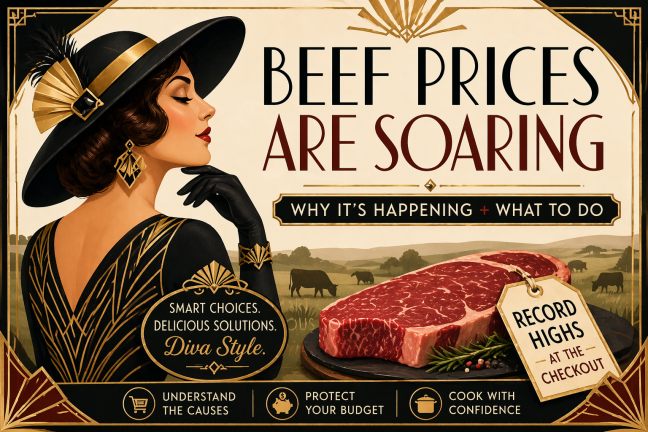
Why Beef Prices Are So High (and Smart Ways to Work Around It)
If you’ve walked past the meat case lately and done a double take (or a spit take), you’re not imagining things.
Beef prices have climbed to the point where many families are making a shift, buying less, skipping it altogether, or standing there wondering how something so familiar suddenly feels like a luxury.
Ground beef, once the dependable backbone of budget-friendly meals, has jumped dramatically in just a few years. Prices have risen by roughly 50% since 2021, with current averages hovering around $6.86 per pound.
Steak? That’s now firmly in “special occasion” territory for many households. I saw ribeye for more than $20 per pound yesterday.
So? What’s going on?
WHY BEEF PRICES ARE SO HIGH (AND STAYING HIGH)

This isn’t just simple inflation. It’s a perfect storm of supply, demand, and long-term challenges that won’t be resolved overnight.
1. There Are Fewer Cattle. A Lot Fewer.
The U.S. cattle herd is at a 75-year low, largely due to years of drought, rising feed costs, and expensive farming conditions. Ranchers have had to reduce herd sizes just to stay afloat, and rebuilding those herds takes time. Years, not months. Experts don’t expect meaningful recovery until at least 2028. Fewer cattle simply means less beef available.
2. It’s More Expensive to Raise Beef
Everything involved in producing beef has become more costly:
- Feed (corn and hay)
- Fuel and transportation
- Fertilizer
- Labor and processing
When it costs more to raise cattle, those costs don’t disappear; producers can’t absorb them, so they show up at the grocery store.
3. Demand Is Still Strong
Here’s the twist: even as prices rise, people are still buying beef. We’re in a bit of a “protein moment,” with many Americans prioritizing high-protein foods for health reasons.
So, we have:
- Less supply
- Higher costs
- Steady (or increasing) demand
That combination keeps prices elevated.
WHAT THIS MEANS FOR YOUR GROCERY BUDGET
In plain terms? Relief isn’t right around the corner. Prices may fluctuate a bit, but the underlying issues suggest that beef will remain expensive for the foreseeable future.
Which means the goal isn’t for beef lovers to “wait it out.” The goal is to adjust strategically without feeling deprived.
HOW TO SOFTEN THE IMPACT (WITHOUT SACRIFICING GOOD FOOD)
This is where you take back control.
1. Use Beef More Intentionally (Not Necessarily Less Joyfully)

Instead of building meals around beef, start using it as a supporting ingredient. Not “meatless” just “less meat.”
Think:
- Tacos with more beans and less meat
- Pasta sauces bulked up with lots of vegetables
- Stir-fries where beef is one element, not the star
You still get the flavor but stretch it further. (Need a guide? Check out our A Cheat Sheet for Stretching Meat!)
2. Shift to “Flavor First” Cooking
Beef often brings umami, richness, and depth, but those can come from other places too. Lean into:
- Caramelized onions cooked low and slow
- Garlic and a variety of spices
- Soy sauce, tomato paste, mushrooms as other sources of umami
You’ll be surprised how satisfying meals can be when flavor does the heavy lifting.
3. Rotate in Lower-Cost Proteins
This isn’t about giving up beef forever; it’s about creating balance. More frequent players:
- Chicken
- Pork
- Eggs
- Beans and lentils
Save beef for when it truly adds value to the meal.
4. Buy Smarter When You Do Buy Beef
- Look for sales and stock up modestly
- Consider less popular cuts (usually more flavorful anyway)
- Use your freezer strategically
5. Let Anticipation Do Some of the Work
When something becomes more expensive, it also becomes more meaningful. Instead of grabbing beef out of habit, plan it: a weekend meal, a family dinner, a dish you genuinely look forward to. You don’t just eat it; you enjoy it twice. Once in the anticipation, and once at the table.
And here’s a little silver lining—whether we like it or not. Even with today’s focus on high-protein diets, not all protein sources are created equal. Leaner options like beans, lentils, fish, eggs, and poultry often provide excellent nutrition with less saturated fat and a lighter environmental and financial footprint. In that sense, the rising cost of beef may be nudging us toward choices that support both our health and our budgets—a rare moment when the grocery bill and good nutrition happen to agree. Let’s enjoy that for a moment, shall we?
A FINAL THOUGHT
This shift can feel frustrating, especially when something as familiar as ground beef suddenly requires a second thought.
But there’s also an opportunity here. To cook more creatively, to waste less, to make choices that are intentional instead of automatic.
And to build a kitchen that works for you, no matter what the market is doing.
Because at the end of the day, it’s not about giving things up. It’s about learning how to use what you have… a little more wisely, and a little more intentionally. And that’s very Diva!